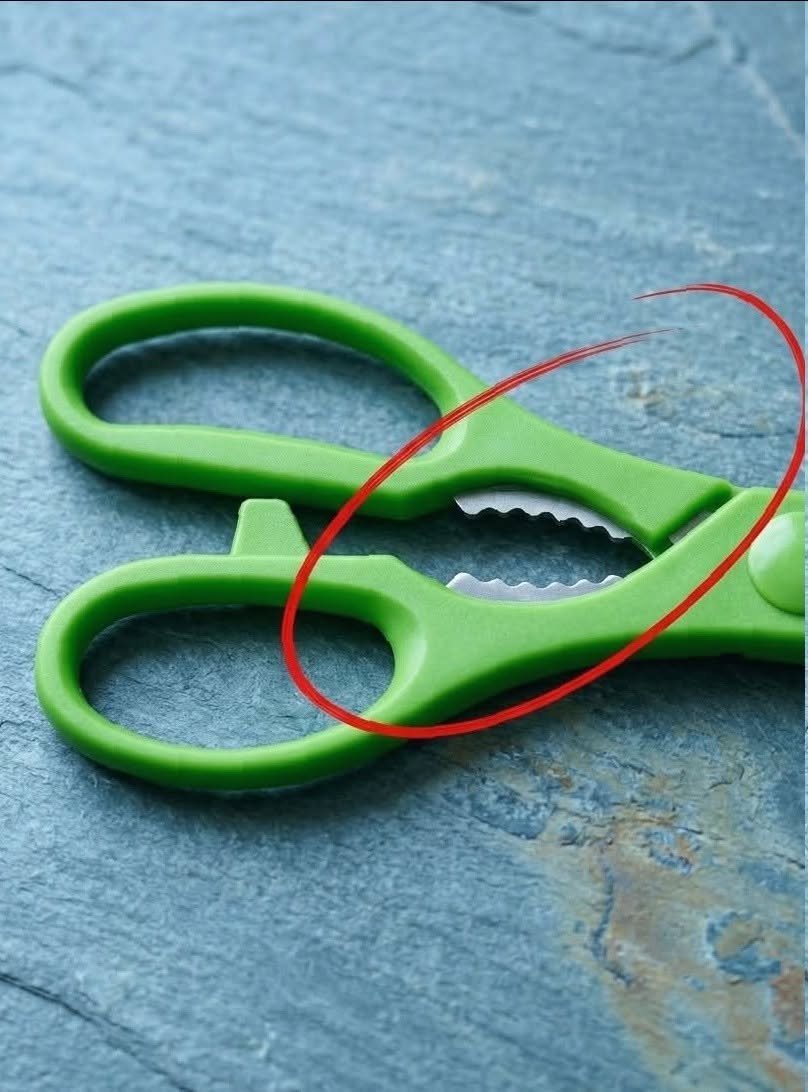
The position is not accidental.
Because the gripping section is close to the pivot point of the scissors, the handles can provide useful leverage. That means you can generate more gripping pressure with relatively little hand movement.
This is one reason the same basic design can be useful for gripping, twisting, or light cracking tasks.
Don’t Confuse It With a Serrated Cutting Blade
There are actually two different types of “serrated” features you might see on kitchen scissors.
A serrated cutting edge is located directly on one of the blades. Its teeth can help the blade hold onto slippery foods or other materials while cutting.
The toothed gripping section, on the other hand, is usually located near the handles or pivot. It is designed to grip or manipulate objects rather than cut them.
A Few Safety Tips
Before using this hidden feature, keep a few things in mind.
- Don’t use lightweight scissors to crack extremely hard objects.
- Make sure the item is securely positioned before applying pressure.
- Keep your fingers away from the teeth.
- Don’t force an object that doesn’t fit properly.
- For large jars, thick shells, or very hard nuts, use a dedicated tool.
- Wash and dry the scissors thoroughly after using them with food.
The feature is designed to make small jobs easier, not to turn ordinary kitchen scissors into heavy-duty tools.
The Next Time You Pick Up Your Kitchen Scissors…
Take a closer look at that strange little row of teeth.
It may be more useful than you thought.
On many multipurpose kitchen scissors, the serrated section works as a small gripping tool that can help with caps, small lids, nuts, shells, and other awkward items. The exact purpose depends on the particular design, so it’s always best to check how your scissors are intended to be used.
A tiny feature that looks mysterious at first can actually turn a simple pair of kitchen scissors into a surprisingly versatile tool.
For Complete Cooking STEPS Please Head On Over To Next Page Or Open button (>)